

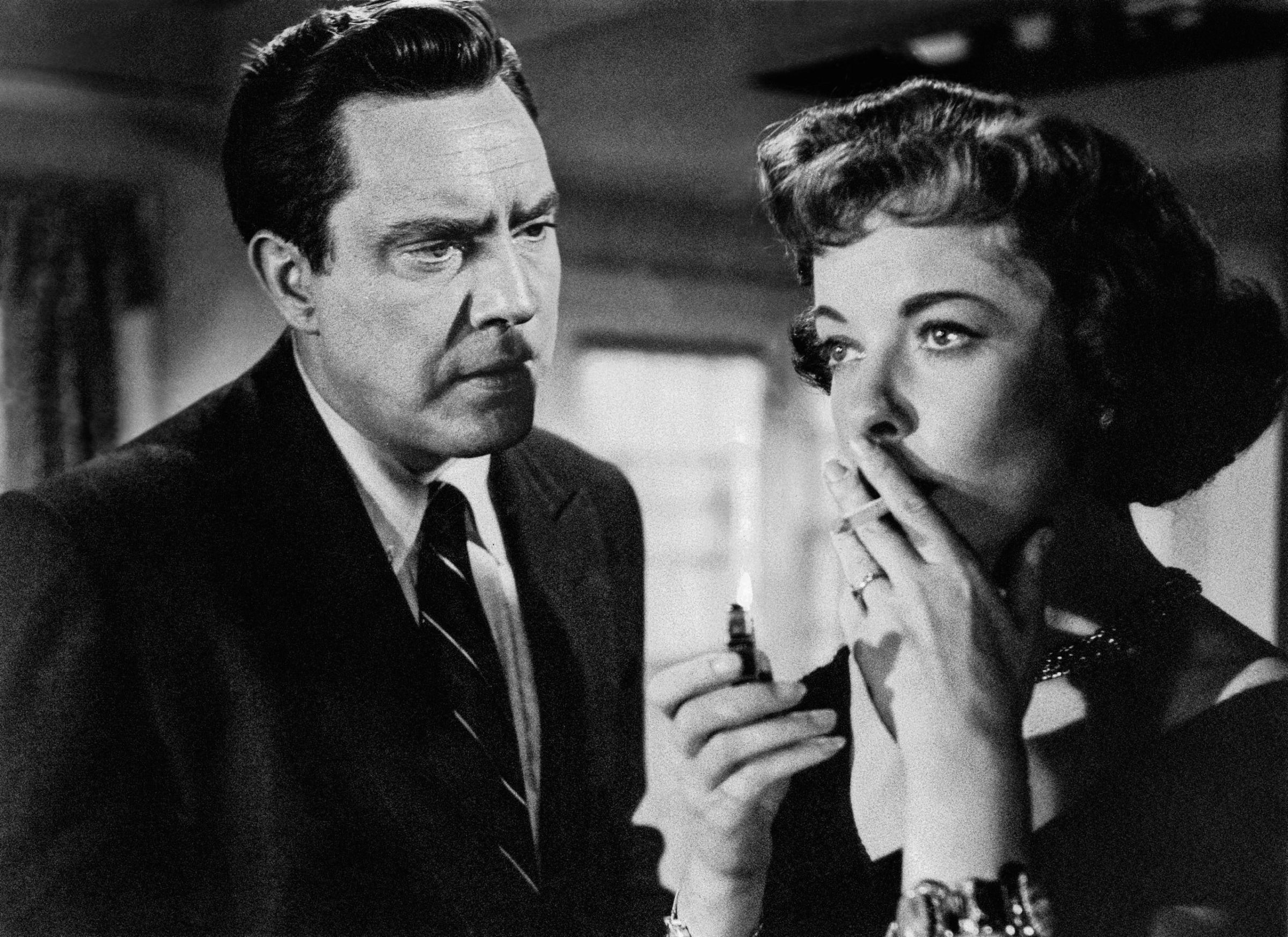
The Bigamist (1953), set in 50s Los Angeles exploring a then taboo subject was ahead of its time and still holds up today. The rarity of it being directed by a woman – pioneer Ida Lupino – makes it more interesting.
The Grahams, Harry (Edmond O’Brien) and Eve (Joan Fontaine), successful business owners decide to adopt a child. The adoption agent Mr. Jordan (Edmund Gwenn) notices the fidgety behaviour of the man when signing the papers permitting an investigation into their private lives that will determine their fitness for parenthood. Jordan’s snooping uncovers the husband’s shocking secret of having another family with a woman, Phyllis (played by Lupino), and as the busted Harry relates to him and the audience in a series of flashbacks how it all came to this, we are left to draw our own conclusions and moral judgments. Is it possible for a man to love two women? Does he know what he wants and who he truly is in his heart? It is hard to stay unmoved by the plights of these sad, flawed, but good people.

Lupino, who was a Hollywood actress with some success, has already directed four and co-directed two pictures by this point (sadly, she only directed one more film after this, then she was relegated to TV work, the Trouble with angels, 1966) and became a trailblazer for women auteurs. Her works displayed a social conscience that was rebellious, controversial, and outspoken yet still remained on the right side of didacticism – partly due to the production code of the time, which prompted inspired visual expression of ideas, while forbade their verbalisation. Still, RKO Pictures has abandoned the film – likely due to the risky subject matter – forcing the filmmakers to distribute it themselves.
With her frequent collaborator and ex-husband, screenwriter Collier Young (married to Fontaine at the time, a strange coincidence), they created a narrative that has an amusing but sparingly used meta-textuality bringing some lightness to the affair – e.g. references to Miracle on 34th street, also starring Edmund Gwenn. They make autobiographical allusions to the auteur’s life – shared husband, child out of wedlock, while simultaneously they hold a magnifying glass to the post-war viewer’s spiritual emptiness. A hidden glance, a quick changing of the subject, a biting of one’s tongue. The filmmaking is precise, unhurried, and full of subtle emotions that build tension until the truth becomes unbearable, augmented by Leith Stevens’ often melancholy score.

Lupino’s direction is much more effective here, than in her suspense-thriller The Hitch-Hiker (1953) where the change of setting and point of view – from the threat of violence inside a confined space – was constantly undermining the film’s sense of momentum. Here, the dynamic switches not only humanize all main characters, but make the dilemma of their interconnectedness all the more felt.
In the title role, Edmond O’Brien has a romantic clumsiness, indecisiveness and emotional vulnerability only hinted at by most of the era’s leading men. He displays the strengths of a successful salesman while not shying away from showing us Harry’s lack of courage. We are in the presence of wounded post-World War 2 masculinity. There is an aching sense that something has been lost.
In light of 50s gendered expectations, the role reversal of the married couple has intriguing complexities; it is the man who needs emotional intimacy and a deep sense of connection. He wants to feel needed, and doesn’t. Interestingly, the lead’s masculine anxiety does not come from his wife’s burgeoning equality and success in the workplace and the dominance she asserts over financial matters, but rather the inability of real closeness that may or may not be interconnected with this independence.

The loneliness of the two women also packs a wallop. Fontaine, playing Eve has a coldness underneath the jovial façade designed to hide her hollowness and to succeed as a career-woman. She is desperate for a child, and cannot have one of her own. Lupino is all husky cynicism hiding warmth and tenderness as Phyllis. She has been toughened by life and betrayals from men. The film admirably shows how these characters try to deal with their alienation in different ways, with all three performers making an impact.
The Bigamist ambiguously alludes to America’s dark past that was quickly brushed under the carpet by post-war prosperity and the baby boom, only to come back to haunt the population, ominously ever-present, without anyone being able to, or wanting to point out where this discontent came from, what it might mean or how to deal with the pain involved. There is no going forward without closure.
Rating: 81%

 Ágoston's Film Odyssey