

This revered favourite of numerous filmmaking masters – Scorsese, Tarkovsky, etc. – has left me cold. It is an admirable feat of visual and narrative storytelling that in the end gave me much to ponder but little to cherish.
Set in 16th century civil war Japan, Ugetsu Monogatari (1953) tells the story of two couples – Genjuro (Masayuki Mori), Miyagi (Kinuyo Tanaka), Tobei (Eitarô Ozawa) and Ohama (Mitsuko Mito) as they try to survive and get lost in the chaos. The men are driven by pride, ego, and greed. The women – even more vulnerable to the obscure norms of social collapse – hold on in increasingly demeaning ways. Genjuro wants to be rich as a master pot maker and Tobei, although just a peasant, wants to be a feared and revered samurai. Miyagi wants togetherness and the warmth of home, to take care of Genjuro and their son, and Ohama mainly wants Tobei to stop embarrassing her with his foolishness. The men desire these things also because they want to make their wives proud – or so they think – while the women seem content and truly want and accept their husbands as they are.
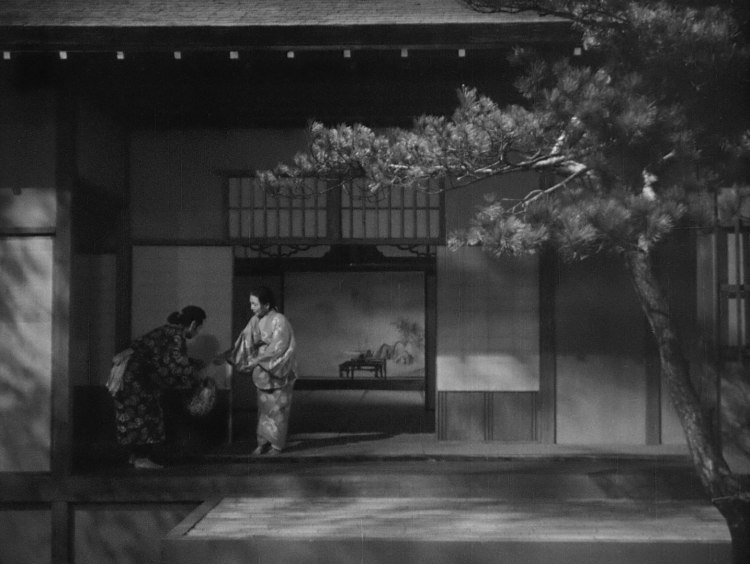
The pre-modernist, fable-like nature of the story – adapted from Ueda Akinari’s Tales of Moonlight and Rain by Matsutarô Kawaguchi, Yoshikata Yoda and Hisakazu Tsuji – and its archetypical characters defy a psychological approach to analysing this film, yet a fundamental human truth is easy to identify here; letting our ego to drive our actions and lead us towards the mirage of our own imagined greatness can only go astray.
Of course, egolessness is also part of the teachings of Buddhism that the film seems to highlight – whether its believers Genjuro and Tobei realise this or not. Despite the feudal caste system that limited one’s options in life to being a peasant, lady, lord, samurai, etc., their destinies and identities become elastic when everyone can be fooled by appearances in the ever-changing pool of upended social order.
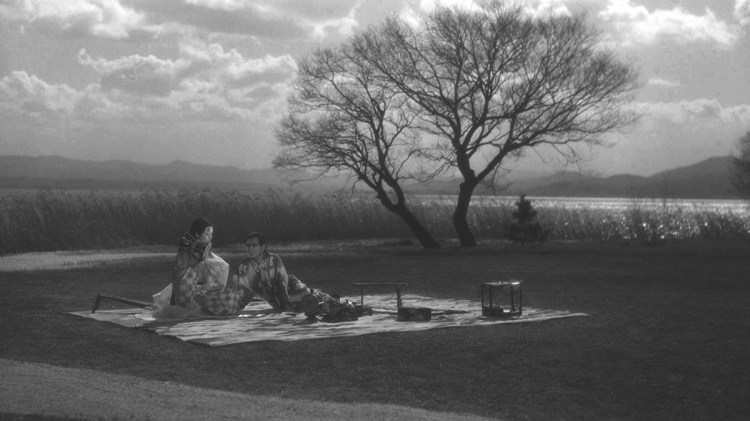
Genjuro and Tobei have the freedom as men to be foolish and to dream while their wives suffer the consequences. Sadly, this affliction appears to be the only path towards character development. Director Kenji Mizoguchi – touted as one of the first feminist filmmakers due to his female-centric films – seems to rightly indicate that men are fundamentally more susceptible to such narcissistic notions, while in those times women barely had a choice of any kind that wouldn’t end in some form of subjugation or exploitation. If your personhood is barely your own and your agency has been taken away by outside forces, to what degree can you be held accountable? Maybe the only path in existence – of this earth or outside of it – is to become a seductive apparition that possesses and devours the soul of her prey and robs him of his agency, like it was done to her in life by the men who rule the world.
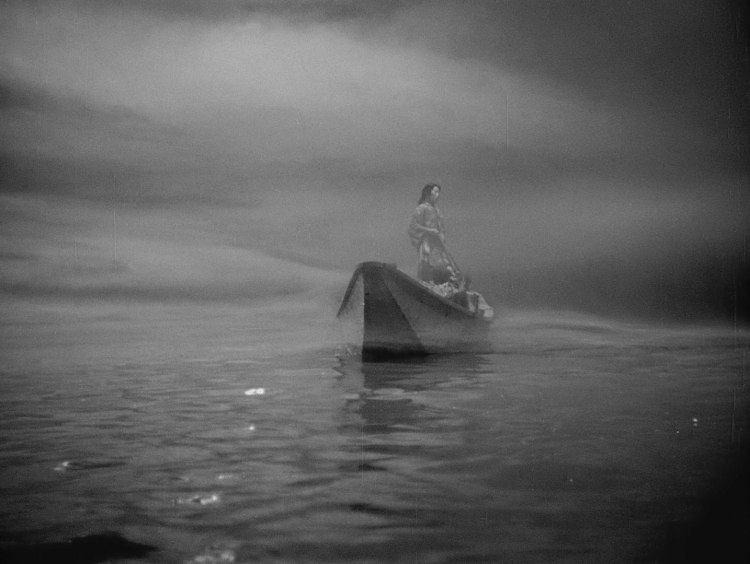
The appearance of the ghost, Lady Wakasa (Machiko Kyô) – who seduces Genjuro with her sensual beauty and the promise of his greatness – opens the narrative to other dimensions that make Ugetsu more complex than it first appears to be. A period piece pre-modernist fable of greed operating with a social realism influenced by neorealism seamlessly transforms itself into a supernatural tale of haunting regret. Mizoguchi’s remarkably expressive direction of long takes and 180 degree cyclical camera movements – that work as framing devices not just for the beginning and end of the story but effect the peeling away of metaphysical layers of reality – displays an ingeniousness and a beauty that is hypnotic. The earthbound clumsiness with which most characters walk, run, fight, exist is contrasted well with the etherealness of the supernatural. The pandemonium of war is not choreographed or graceful but awkward, cruel and foolish.
I felt that a tale like this demanded not just patience and commitment from the audience, but a soulful humanism vice-versa that I have found lacking inside the skeleton of the film and was not willing to project onto or supply on the filmmaker’s behalf. Yielding to such demand would have taken away from my own soul instead of nourishing it. I was touched by grey claws and a ghostly celluloid figure with an ashen face and black eyes stared into me.
Ugetsu can be a punishing 97 minutes that has plenty of ingenious visual, aural, narrative and world-building choices that serve as hollow rewards in the end. The women are martyrs or phantoms, the men are louts. Their realisations arrive not by their own suffering or striving towards self-awareness, but due to the tragic lot of others they never truly cared for, thus they remain unearned and false.
Life – of no particular importance – goes on.
Rating: 58%

 Ágoston's Film Odyssey